What the regulations are
The Children’s Homes (England) Regulations 2015 (SI 2015/541) came into force on 1 April 2015. They contain 57 regulations and five Schedules. Together they set out the standards of care children must receive, who may run and manage a home, the records that must be kept, what must be reported and to whom, and the checks the provider must make on its own service.
The Department for Education’s Guide to the Children’s Homes Regulations including the quality standards explains what the regulations mean in practice. It is not law itself, but it sets out what the Department expects, and Ofsted inspectors refer to it.
The nine Quality Standards (regulations 6 to 14)
The Quality Standards describe the outcomes children should experience. Each is a regulation in its own right.
| Reg | Standard | In short |
|---|---|---|
| 6 | Quality and purpose of care | Care that matches the Statement of Purpose and each child's plans, in a home that is homely and suitable. |
| 7 | Children's views, wishes and feelings | Children are listened to, their views are taken into account, and they know how to complain and get an advocate. |
| 8 | Education | Each child is helped to achieve their education and training targets. |
| 9 | Enjoyment and achievement | Children take part in activities that interest them and build their skills. |
| 10 | Health and well-being | Each child's physical, emotional and mental health needs are met. |
| 11 | Positive relationships | Children are helped to develop positive relationships and to manage their behaviour. |
| 12 | Protection of children | Staff assess and reduce the risk of harm to each child, including going missing and exploitation. |
| 13 | Leadership and management | Leaders run the home in line with the Statement of Purpose, with enough skilled, supervised staff. |
| 14 | Care planning | Children are admitted only if the home can meet their needs, and plans are put into practice. |
The recurring duties and deadlines
Most enforcement action does not start with poor care on a single day. It starts with duties that should happen on a cycle and quietly stop happening.
| Rule | Duty | How often | Deadline |
|---|---|---|---|
| Regulation 44 | Independent person visits and reports | At least once a month | Report to Ofsted by the end of the following month |
| Regulation 45 | Review of quality of care | At least every 6 months | Report to Ofsted within 28 days |
| Regulation 46 | Review of the location of premises | At least once each calendar year | Kept with the location risk assessment |
| Regulation 35 | Restraint and other measures recorded | Every time a measure is used | 24-hour record, 48-hour sign-off, 5-day conversation with the child |
| Regulation 40 | Notification of serious events | Each event | Without delay, in writing |
| Regulation 41 | Admissions and discharges | Each admission and discharge | Without delay, to the local authority where the home is |
| Regulation 16 | Statement of Purpose | Kept under review | Revised when the home changes |
Case records under regulation 36 must be kept up to date, with each entry signed and dated by the person who wrote it. The DfE guide says case records must be kept for 75 years from the child’s date of birth.
How the Residential Childcare App handles this
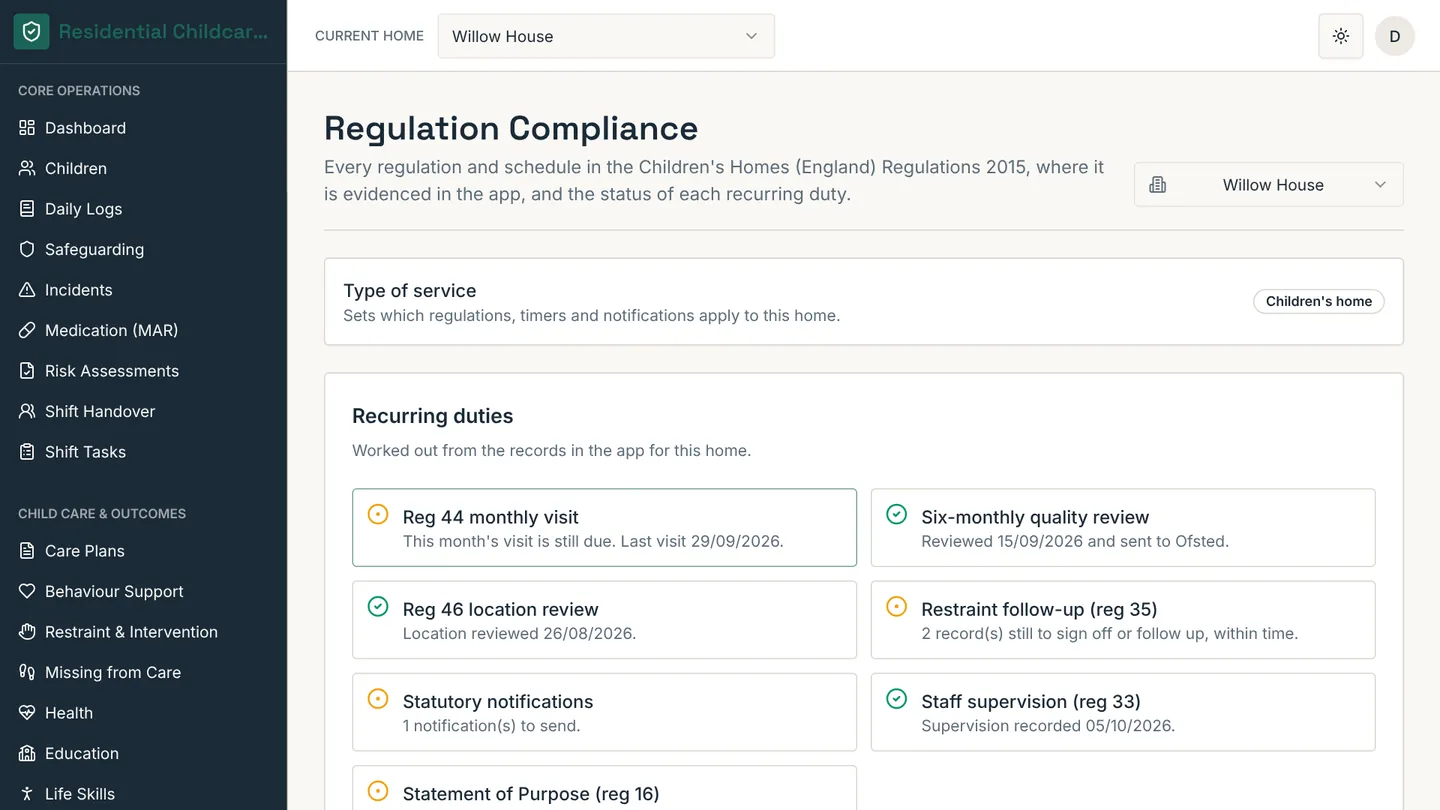
The compliance hub works out each of these cycles from the home’s own records and shows what is due, what is done and what is late, for every home.
How Ofsted uses the regulations
Ofsted inspects children’s homes under the Social Care Common Inspection Framework (SCCIF). Inspectors make three judgements: the overall experiences and progress of children, how well children are helped and protected, and the effectiveness of leaders and managers. Each is graded outstanding, good, requires improvement to be good, or inadequate.
Where a home is not meeting a regulation, inspectors can set requirements with deadlines, and Ofsted can take enforcement action. Our inspection evidence guide sets out the records inspectors sample.
Search every regulation and Schedule
Search by word or number, or filter by the Ofsted judgement each regulation mostly bears on. Open any entry for its key duties, where it is evidenced, and a link to the official text.
Showing 62 of 62
Reg 1Citation, commencement and applicationSets when the regulations apply. No record needed.
Key duties
- In force 1 April 2015
- Apply only to children's homes in England
- Apply to an accommodated person aged 18+ (not employed at the home) as if a child
Reg 2InterpretationDefinitions used throughout, such as "child protection policies" and "children's guide".
Key duties
- 'child protection policies' = safeguarding policy, anti-bullying policy and missing child policy under reg 34
- 'children's guide' = document explaining in age-appropriate form what children can expect, support entitlements, how to complain and access advocacy
- 'relevant plans' = placement plan, care plan, EHC plan/SEN statement and, for youth justice children, detention/sentencing plans
- 'placing authority' = local authority, voluntary organisation, youth offending team or parent depending on circumstances
- 'case records' = records under reg 36; 'statement of purpose' = statement under reg 16
- 'health' includes emotional, mental and physical health
Reg 3Excepted establishmentsLists establishments that are not children's homes. No record needed.
Key duties
- FE sector institutions excepted
- 16 to 19 Academies (other than secure) excepted
- Holiday/cultural/educational/recreational/sporting accommodation excepted if no child accommodated >27 days in any 12 months
- Childcare premises excepted if childcare for any one child not >27 days in 12 months (not where children wholly/mainly within CSA 2000 s3(2))
- Days with 9+ hours in care of parent/relative without childcare not counted toward 27 days
- Accommodation for 16+ for apprenticeship/training, holiday, or cultural etc. purposes excepted
Reg 4Quality standards for children's homesThe nine Quality Standards (regs 6 to 14) that every home must meet.
Key duties
- (a) quality and purpose of care (reg 6)
- (b) children's views, wishes and feelings (reg 7)
- (c) education (reg 8)
- (d) enjoyment and achievement (reg 9)
- (e) health and well-being (reg 10)
- (f) positive relationships (reg 11)
Evidenced in the app: Compliance Hub
Read reg 4 on legislation.gov.ukReg 5Engaging with the wider system to ensure children's needs are metWork with placing authorities and other services, and challenge them when they fall short.
Key duties
- (a) seek to involve each child's placing authority effectively in the child's care, in line with relevant plans
- (b) seek to secure the input and services required to meet each child's needs
- (c) challenge a placing authority or relevant person whose performance/response is considered inadequate, to seek to ensure needs are met per relevant plans
- (d) seek to develop and maintain effective professional relationships with persons/bodies the registered person considers appropriate given the range of needs in the statement of purpose
Evidenced in the app: Professionals, Care Plans, Chronology
Read reg 5 on legislation.gov.ukReg 6The quality and purpose of care standardUnderstand and apply the Statement of Purpose; personalised care that protects and promotes welfare.
Key duties
- Registered person must understand and apply the statement of purpose
- Ensure staff: understand and apply the statement of purpose; protect and promote each child's welfare; treat each child with dignity and respect; provide personalised care meeting needs in relevant plans, taking account of background; help each child understand and manage impact of abuse or neglect; help each child develop resilience and skills to return home, move to a new placement or live independently; provide physical necessities to live comfortably; provide personal items appropriate to age and understanding; make day-to-day decisions per relevant plans giving appropriate freedom and choice
- Ensure premises designed and furnished to meet each child's needs and enable participation in daily life
- Any development/health care not provided via the NHS must: be approved and kept under review by the placing authority; meet the child's needs; be delivered by someone with experience, knowledge and skills under supervision of an appropriately skilled and qualified person; and the child's GP must be kept informed as necessary of progress
Evidenced in the app: Policy Engine, Daily Logs, Care Plans
Read reg 6 on legislation.gov.ukReg 7The children's views, wishes and feelings standardFind out and act on each child's views, wishes and feelings, and explain decisions.
Key duties
- Staff ascertain and consider each child's views, wishes and feelings, balanced against best interests
- Help each child express views and understand how they were taken into account, with reasons for decisions
- Regularly consult children and seek feedback on quality of care
- Help each child understand how privacy will be respected and when it may be limited
- Help each child prepare for reviews of relevant plans and make views known
- Make each child aware of (and remind them of) the children's guide, how to complain/make representations, and advocacy available
Evidenced in the app: Child's Voice
Read reg 7 on legislation.gov.ukReg 8The education standardHelp each child meet education targets and overcome barriers to learning.
Key duties
- Help each child achieve education and training targets in relevant plans
- Support learning and development, including independent study skills
- Understand barriers to learning and act to help overcome them
- Help each child understand the value of education, learning, training and employment
- Promote opportunities to learn informally
- Maintain regular contact with each child's education/training provider, engaging with provider and placing authority
Evidenced in the app: Education
Read reg 8 on legislation.gov.ukReg 9The enjoyment and achievement standardHelp each child develop interests, hobbies and achievements.
Key duties
- Staff help each child develop interests and hobbies
- Staff help each child participate in activities they enjoy which meet and expand their interests
- Staff help each child make a positive contribution to the home and wider community
- Each child has access to a range of activities to pursue interests and hobbies
Evidenced in the app: Life Skills, Goals & Outcomes
Read reg 9 on legislation.gov.ukReg 10The health and well-being standardHelp each child achieve health and well-being outcomes and attend appointments.
Key duties
- Staff help each child achieve health and well-being outcomes in relevant plans
- Help each child understand their health needs and options appropriate to age and understanding
- Help each child take part in activities and attend appointments to meet health needs
- Help each child understand and develop skills to promote well-being
- Each child registered with a GP and a registered dental practitioner
- Each child has access to dental, medical, nursing, psychiatric and psychological advice, treatment and services as required
Evidenced in the app: Health, Medication
Read reg 10 on legislation.gov.ukReg 11The positive relationships standardMeet behavioural and emotional needs and build positive relationships.
Key duties
- Meet each child's behavioural and emotional needs per relevant plans
- Help develop socially aware behaviour and take responsibility for behaviour
- Help develop skills to resolve conflicts positively and without harm
- Communicate behaviour expectations and ensure they are understood
- Help each child understand personal, sexual and social relationships and how they can be supportive or harmful
- Help each child recognise or withdraw from damaging, exploitative or harmful relationships
Evidenced in the app: Behaviour Support, Family & Contact
Read reg 11 on legislation.gov.ukReg 12The protection of children standardAssess each child's risk of harm, reduce it, and help children keep safe.
Key duties
- Staff assess whether each child is at risk of harm (using relevant plans) and make arrangements to reduce risk
- Help each child understand how to keep safe
- Staff have skills to identify and act on signs of risk of harm
- Manage relationships between children to prevent harm to each other
- Staff understand protection roles assigned by the registered person
- Take effective action whenever there is a serious concern about a child's welfare
Evidenced in the app: Safeguarding, Risk Assessments, Missing from Care, Incidents
Read reg 12 on legislation.gov.ukReg 13The leadership and management standardLead and manage in line with the Statement of Purpose, with enough skilled staff.
Key duties
- Lead and manage consistently with the approach, ethos and outcomes in the statement of purpose
- Ensure staff work as a team where appropriate
- Ensure staff have experience, qualifications and skills to meet each child's needs
- Ensure sufficient staff to provide care for each child
- Ensure workforce provides continuity of care
- Understand impact of quality of care on each child's progress and experiences and use it to develop care
Evidenced in the app: Management Oversight, Quality Assurance, Improvement Plan, Audits
Read reg 13 on legislation.gov.ukReg 14The care planning standardAdmit only children whose needs fit the Statement of Purpose; plan induction, reviews and moving on.
Key duties
- Admit children only if their needs are within the range in the statement of purpose
- Arrangements for effective induction of each child
- Arrangements to manage and review each placement
- Plan for and help each child prepare to leave or move to adult care consistent with arrangements agreed with the placing authority
- Ensure each child's relevant plans are followed
- Promote contact with parents, relatives and friends per relevant plans (subject to reg 22)
Evidenced in the app: Children, Care Plans
Read reg 14 on legislation.gov.ukReg 15Duty to have regard to statements of standards published under section 23 of the Care Standards Act 2000Have regard to any statement of standards the Secretary of State publishes.
Key duties
- Have regard to any s23 statement of standards published by the Secretary of State
Evidenced in the app: Policy Engine
Read reg 15 on legislation.gov.ukReg 16Statement of purposeKeep a Statement of Purpose (Schedule 1) and a children's guide, send to Ofsted and review them.
Key duties
- Compile a statement of purpose covering Schedule 1 matters
- Provide a copy to HMCI
- Make available on request to: staff; a child or prospective child; a parent of a child or prospective child; a placing authority; the Secretary of State (qualifying school)
- Keep under review and revise where appropriate
- Notify HMCI of revisions and send the revised statement within 28 days of the revision
- Publish on the home's website if it has one, unless publication would prejudice children's welfare
Evidenced in the app: Policy Engine, Compliance Hub
Read reg 16 on legislation.gov.ukReg 17Placement plan for looked after childAgree and sign the placement plan with the placing authority.
Key duties
- Co-operate with the placing authority in agreeing and signing the placement plan
- Provide information about the child on request
- Provide a suitable representative to attend placing authority meetings about the child on request
- For a youth justice child, have regard to remand/sentencing plans
Evidenced in the app: Care Plans
Read reg 17 on legislation.gov.ukReg 18Placement plan for a child who is not looked afterPlacement plan for a child who is not looked after.
Key duties
- If placed by a voluntary organisation: co-operate in agreeing and signing its placement plan
- Otherwise prepare a placement plan before admission or, if not reasonably practicable, as soon as possible after admission
- Plan must set out: day-to-day care and how welfare will be safeguarded and promoted; care, education and health arrangements; contact arrangements with parents, relatives and friends
- Consult the placing authority when preparing
- Keep under review and revise as necessary
- Seek and take account of the child's views (age and understanding); for youth justice children have regard to remand/sentencing plans
Evidenced in the app: Care Plans
Read reg 18 on legislation.gov.ukReg 19Behaviour management and disciplineBanned disciplinary measures, such as corporal punishment or withholding food or contact.
Key duties
- Prohibited as discipline: corporal punishment
- Punishment involving consumption or deprivation of food or drink
- Restricting contact/visits with parents, relatives or friends, communications with reg 22(1) persons, or access to internet/telephone counselling helplines (other than by court or under reg 22)
- Use or withholding of medication or medical/dental treatment
- Intentional deprivation of sleep
- Financial penalty (other than reasonable reparation, possibly by instalments)
Evidenced in the app: Behaviour Support, Policies
Read reg 19 on legislation.gov.ukReg 20Restraint and deprivation of libertyRestraint only to prevent injury, serious damage to property or absconding from a secure home; necessary and proportionate.
Key duties
- Restraint only to prevent injury to any person, serious damage to property, or absconding from a secure children's home
- Restraint must be necessary and proportionate
- Deprivation of liberty only where authorised by court order
- Recording of restraint is under reg 35(3) (not reg 20)
Evidenced in the app: Restraint & Intervention
Read reg 20 on legislation.gov.ukReg 21Privacy and accessProtect children's privacy; any limits must be necessary, proportionate and reviewed.
Key duties
- Protect children's privacy appropriately
- Children can access all appropriate areas of the premises
- Any limitation on privacy/access must: be intended to safeguard each child; be necessary and proportionate; be kept under review and revised if necessary; allow as much freedom as possible balanced against safety
Evidenced in the app: Policies, Risk Assessments
Read reg 21 on legislation.gov.ukReg 22Contact and access to communicationsPrivate contact with family, advocates, social workers and the Reg 44 independent person.
Key duties
- Provide suitable facilities to meet privately at any reasonable time with parents, friends, relatives, solicitor/adviser/advocate, Cafcass officer, social worker, person authorised by HMCI, person authorised by the local authority, independent visitor, person authorised by the Secretary of State under s80(2) CA 1989, person appointed under the 2006 Representations Procedure Regulations, and the reg 44 independent person
- Paras (1A)-(1D) (shown in revised text): meetings may be by phone/video where coronavirus guidance or impracticability applies, and a record must be kept of such meetings - CHECK currency, these were coronavirus provisions
- Facilities may be at a different address if a s51 CA 1989 certificate is in force
- Provide at all reasonable times private telephone access and private post (and email if provided), usable without reference to staff
- Provide disabled children with communication aids and equipment
- May impose conditions/prohibitions/restrictions on contact or communications only if necessary to safeguard or promote welfare
Evidenced in the app: Family & Contact, Visitors
Read reg 22 on legislation.gov.ukReg 23MedicinesSafe handling, recording, storage, giving and disposal of medicines.
Key duties
- Arrangements for handling, recording, safekeeping, safe administration and disposal of medicines
- Store medicines securely so no child has unsupervised access
- Administer prescribed medicine as prescribed only to the child it is prescribed for
- Keep a record of administration of medicine to each child
- Exemption: medicine stored by the child so others cannot use it and safely self-administered
Evidenced in the app: Medication
Read reg 23 on legislation.gov.ukReg 24Monitoring and surveillanceSurveillance only to safeguard, with placing authority consent and the child told.
Key duties
- Purpose must be safeguarding and promoting welfare of the child or other children
- Placing authority must consent in writing
- Child informed in advance so far as reasonably practicable given age and understanding
- No more intrusive than necessary having regard to privacy
- Subject to any court-imposed requirements
Evidenced in the app: Policies, Risk Assessments
Read reg 24 on legislation.gov.ukReg 25Fire precautionsConsult the fire service, keep fire equipment and escape routes, train staff, hold drills.
Key duties
- Consult the fire and rescue authority
- Adequate fire precautions including suitable fire equipment
- Adequate means of escape
- Suitable fire prevention training for staff
- Fire drills and practices at suitable intervals so staff and (so far as reasonably practicable) children know the procedure
- If the Fire Safety Order 2005 applies: comply with it and its regulations (except art 23) instead
Evidenced in the app: Fire Safety
Read reg 25 on legislation.gov.ukReg 26Fitness of registered providerThe provider, its directors and the RI are fit to carry on the home.
Key duties
- Individual provider/each partner/each co-provider: integrity and good character; full and satisfactory Schedule 2 information; mentally and physically fit; financially fit
- Organisation: each involved director (other than the RI) of integrity and good character with Schedule 2 paras 1 and 3-6 information; organisation must notify HMCI of the RI's name, address and position
- Responsible individual: meets integrity/character, Schedule 2 information and mental/physical fitness, and has capacity, experience and skills to supervise management of the home(s)
- Not financially fit if undischarged bankrupt/sequestration/debt relief order moratorium, or undischarged composition or arrangement with creditors
- 'Director' includes anyone performing equivalent functions
Evidenced in the app: Provider Governance, Safer Recruitment Checks
Read reg 26 on legislation.gov.ukReg 27Appointment of managerAppoint a manager when needed and tell Ofsted without delay.
Key duties
- Appoint a manager if no registered manager and provider is an organisation/partnership, does not satisfy reg 28, or is not/does not intend to be in day-to-day charge
- Notify HMCI without delay of the appointee's name and date appointment takes effect
Evidenced in the app: Provider Governance, Statutory Notifications
Read reg 27 on legislation.gov.ukReg 28Fitness of managerThe manager is fit, experienced and holds (or is working towards) the Level 5 diploma.
Key duties
- Integrity and good character
- Appropriate experience, qualification and skills to manage the home and lead care, having regard to size, statement of purpose and children's needs
- Physically and mentally fit
- Full and satisfactory Schedule 2 information
- Experience: within last 5 years worked at least 2 years in a position relevant to residential care of children; and at least 1 year supervising and managing staff in a care role
- Qualification: Level 5 Diploma in Leadership and Management for Residential Childcare (England) or a qualification the registered provider considers equivalent, by the relevant date
Evidenced in the app: Qualifications, Safer Recruitment Checks, Provider Governance
Read reg 28 on legislation.gov.ukReg 29Continuing professional development: registered person and responsible individualThe provider, RI and manager keep up their professional development.
Key duties
- Individual provider undertakes necessary CPD for carrying on the home
- Organisation ensures the RI undertakes CPD for supervising management
- Partnership ensures one partner undertakes CPD
- Registered manager undertakes CPD for managing the home
Evidenced in the app: Provider Governance, Learning
Read reg 29 on legislation.gov.ukReg 30Compliance with regulationsA duty is met if any one registered person meets it.
Reg 31Staffing of children's homesContinuity of staffing, and a first aider on duty at all times.
Key duties
- Use of temporary staff must not prevent reasonable continuity of care
- At all times at least one person on duty with a suitable first aid qualification
- Anyone working as a nurse must be a registered nurse
Evidenced in the app: Rota & Staffing, Training
Read reg 31 on legislation.gov.ukReg 32Fitness of workersSafer recruitment; Level 3 diploma within two years for care staff.
Key duties
- Use recruitment procedures designed to ensure children's safety
- Only employ, or allow others' employees with regular contact to work, if: integrity and good character; appropriate experience, qualification and skills; mentally and physically fit; full and satisfactory Schedule 2 information
- Care role staff: Level 3 Diploma for Residential Childcare (England) or equivalent the registered person considers equivalent, by the relevant date
- Relevant date: 2 years after starting in a care role (if started after 1 April 2014); 1 April 2016 if in role on 1 April 2014; may be deferred for prolonged absence or part-time
- Exceptional early start allowed only if: all reasonable steps taken; Schedule 2 paras 1 (ID/photo) and 2 (DBS) complete; only paras 3-6 outstanding; circumstances exceptional; appropriate supervision pending outstanding information
- Take reasonable steps to supervise other individuals working at the home not covered above
Evidenced in the app: Safer Recruitment Checks, Qualifications
Read reg 32 on legislation.gov.ukReg 33Employment of staffInduction, probation, supervision and yearly appraisal for every employee.
Key duties
- Each employee completes an appropriate induction
- Permanent appointments subject to satisfactory probation
- Each employee given a job description
- Disciplinary procedure providing for suspension where needed for children's safety/welfare
- Disciplinary procedure makes failure to report abuse or suspected abuse (past or present) to the appropriate person (registered person, HMCI officer, local authority officer or police officer) a ground for disciplinary proceedings
- All employees undertake appropriate CPD
Evidenced in the app: Training, Supervision, Staff Profiles, Disciplinary
Read reg 33 on legislation.gov.ukReg 34Policies for the protection of childrenSafeguarding, anti-bullying and missing child policies, and how allegations are handled.
Key duties
- Safeguarding policy to protect children from abuse or neglect, setting out the procedure for allegations
- Allegations procedure must: provide for liaison with local authorities making child protection enquiries; prompt referral of current/ongoing abuse allegations to the placing authority and (if different) the host local authority; prompt referral of past abuse allegations to the placing authority and (if different) the local authority where it occurred; records of allegations and action taken; protective measures following an allegation; how and to whom staff report concerns without delay
- Anti-bullying policy including procedure for dealing with allegations of bullying
- Missing child policy: steps to prevent absence without permission; procedures, roles and responsibilities when a child is or has been absent
- Before implementing or substantively amending the missing child policy: consult and take account of each relevant person's views; have regard to local authority/police missing children protocols
- Keep child protection policies under review and revise as necessary
Evidenced in the app: Policies, Policy Engine, Safeguarding
Read reg 34 on legislation.gov.ukReg 35Behaviour management policies and recordsBehaviour policy; record restraint within 24 hours, registered person signs within 48 hours, speak to the child within 5 days.
Key duties
- Prepare and implement a behaviour management policy setting out how appropriate behaviour is promoted and the measures of control, discipline and restraint that may be used; keep under review
- Record within 24 hours: child's name; behaviour leading to measure; date, time and location; description and duration; methods/steps used to avoid the measure; name of user and others present; effectiveness and consequences; any injury and medical treatment
- Within 48 hours the registered person or authorised person has spoken to the user and signed the record as accurate
- Within 5 days the registered/authorised person adds confirmation they have spoken to the child
- Recording duties do not apply to restraint planned/routinely provided for in an EHC plan or SEN statement
Evidenced in the app: Restraint & Intervention, Behaviour Support, Policies
Read reg 35 on legislation.gov.ukReg 36Children's case recordsCase records (Schedule 3), signed and dated by their author, kept 75 years from birth.
Key duties
- Maintain case records containing Schedule 3 information, kept up to date, each entry signed and dated by its author
- Retain for 15 years from death if child dies before 18; otherwise 75 years from date of birth
- Keep securely in the home while child accommodated; in a secure place afterwards
- On closure: transfer to the provider's other home (or nearest other home if several)
- If no other home: transfer looked-after children's records to placing authority; non-looked-after children's records to the authority responsible for the EHC plan/SEN statement, or otherwise to the placing authority
Evidenced in the app: Children, Daily Logs, Chronology, Security & Audit Trail
Read reg 36 on legislation.gov.ukReg 37Other recordsOther records (Schedule 4), kept at least 15 years.
Key duties
- Maintain Schedule 4 records in the home
- Keep them up to date
- Retain at least 15 years from date of last entry
Evidenced in the app: Children, Visitors, Fire Safety, Complaints
Read reg 37 on legislation.gov.ukReg 38Storage of records etc.Records and policies kept safe and available to Ofsted.
Key duties
- Statement of purpose
- Children's guide
- Placement plans for non-looked-after children (reg 18)
- Safeguarding policy; anti-bullying policy; missing child policy (reg 34)
- Behaviour management policy and records of control, discipline or restraint (reg 35)
- Case records (reg 36) and other records (reg 37)
Evidenced in the app: Security & Audit Trail, Exports
Read reg 38 on legislation.gov.ukReg 39Complaints and representationsA complaints procedure for children, with records of action and outcome.
Key duties
- Establish a procedure for considering complaints by or on behalf of children
- Person complained about takes no part in consideration/investigation (except informal resolution if appropriate)
- Record each complaint, action taken and outcome of any investigation
- No reprisal against any child for complaining or making representations
- On HMCI request supply a summary of complaints in the preceding 12 months and action taken on each
Evidenced in the app: Complaints
Read reg 39 on legislation.gov.ukReg 40Notification of a serious eventNotify Ofsted and others without delay of serious events, in writing.
Key duties
- Death of a child - notify without delay: HMCI; placing authority; Secretary of State (if not placing authority); host local authority (if not placing authority); integrated care board for the area; the Prisons and Probation Ombudsman (secure children's home only); each other relevant person
- Death in a secure children's home - allow PPO access to premises, documents and records, to take secure copies, and to interview in private (with consent) children, parents/relatives and staff
- Referral of a person working in the home under s35 Safeguarding Vulnerable Groups Act 2006 - notify without delay: HMCI; placing authority; each other relevant person
- Notify HMCI and each other relevant person without delay if: (a) a child is involved in or subject to, or suspected of being involved in or subject to, sexual exploitation; (b) an incident requiring police involvement occurs which the registered person considers serious; (c) there is an allegation of abuse against the home or a person working there; (d) a child protection enquiry is instigated, or concludes (notification to include the outcome); (e) any other incident relating to a child the registered person considers serious
- Each notification must include details of the matter, the other persons/bodies notified, and any actions taken by the registered person
- Must be made or confirmed in writing
Evidenced in the app: Statutory Notifications, Incidents
Read reg 40 on legislation.gov.ukReg 41Notification with respect to children admitted into, or discharged from, a children's homeNotify the host local authority of each admission and discharge.
Key duties
- Notify host local authority without delay of every admission and discharge (not required if it is the placing authority)
- Notification in writing stating: child's name and date of birth; whether accommodated under s20 or s21 CA 1989 (or s76/77 SSWB(W)A 2014); whether subject to a s31 care or supervision order; contact details of placing authority and IRO; whether child has an EHC plan/SEN statement and responsible local authority
Evidenced in the app: Statutory Notifications, Children
Read reg 41 on legislation.gov.ukReg 42Notification of offencesNotify Ofsted of any conviction of a registered person, RI, director or partner.
Key duties
- Applies to registered provider, registered manager, responsible individual, directors (organisation), partners (partnership)
- Notify HMCI in writing without delay of date and place of conviction, the offence and the penalty
Evidenced in the app: Statutory Notifications
Read reg 42 on legislation.gov.ukReg 43Appointment of independent personAppoint a truly independent person to visit and report on the home.
Key duties
- Registered provider appoints, at its own expense, an independent person to visit and report on the home
- Same person may be appointed for all or any of the provider's homes
- Cannot be appointed: (a) if provider is a local authority, its employee in connection with its children's social services functions; (b) if not a local authority, a person employed for payment by the provider; (c) a person involved in preparing the care plan of any child placed there, or their manager/supervisor; (d) a person responsible for commissioning or financing the home's services; (e) a person with a financial interest in the home; (f) the responsible individual; (g) a person with a connection to the registered person, a staff member or a child that the provider considers raises doubts about impartiality
- Exception: provider's employee employed solely to critically examine how a home is carried on/managed and the quality of care is not disqualified under (a), (b) or (g) by that employment alone
- Exception: a local authority IRO is not disqualified under (a), (c) or (g) by that appointment alone
- Independent person must declare any actual or potential conflict of interest to the provider without delay and, if reasonably practicable, before a visit
Evidenced in the app: Regulation 44
Read reg 43 on legislation.gov.ukReg 44Independent person: visits and reportsMonthly independent visit and a report on safeguarding and well-being, sent to Ofsted and others.
Key duties
- Registered person ensures an independent person visits at least once each month
- Registered person helps the independent person: interview in private (with consent) children, parents, relatives and staff as required; inspect premises and records as required (case records only with consent of child and placing authority)
- Visits may be unannounced
- Report must set out, in particular, opinion on whether (a) children are effectively safeguarded and (b) the conduct of the home promotes children's well-being
- Report may recommend actions and timescales within which the registered person must consider whether to take them
- If a conflict of interest becomes known after a visit, report must include details and why the provider was not notified beforehand
Evidenced in the app: Regulation 44
Read reg 44 on legislation.gov.ukReg 45Review of quality of careQuality of care review at least every six months, sent to Ofsted within 28 days.
Key duties
- Complete a quality of care review at least once every 6 months
- Maintain a system monitoring, reviewing and evaluating quality of care, children's feedback/opinions on the home, facilities and care, and actions to improve or maintain quality
- System must ascertain and consider opinions of children, parents, placing authorities and staff
- Produce a written quality of care review report covering the review and intended actions
- Supply report to HMCI within 28 days of completing the review
- Make copy available on request to a placing authority (if not the child's parent)
Evidenced in the app: Regulation 45
Read reg 45 on legislation.gov.ukReg 46Review of premisesReview the location of the premises at least once every calendar year.
Key duties
- Review appropriateness and suitability of the location of premises at least once each calendar year
- Take into account reg 12(2)(c) (premises located so children effectively safeguarded)
- Consult and take into account the views of each relevant person
Evidenced in the app: Provider Governance, Policy Engine
Read reg 46 on legislation.gov.ukReg 47Financial positionKeep the home financially viable, with records available to Ofsted.
Key duties
- Carry on the home so it is likely to be financially viable for the statement of purpose aims
- Maintain adequate, up-to-date financial records
- Supply financial records and most recent accounts to HMCI on request
- Provide HMCI with viability information it requires, including: accountant-certified annual accounts; bank reference on provider's financial standing; information on financing and resources; associated company information (if a company); certificate of insurance for liability for damage, death, injury, public liability or other loss
Evidenced in the app: Provider Governance, House Finance
Read reg 47 on legislation.gov.ukReg 48Notice of absenceTell Ofsted at least a month ahead about any absence of 28 days or more by the person in charge.
Key duties
- Notify HMCI in writing of proposed absence of person in day-to-day charge for continuous 28 days or more
- Notice no later than one month before (or shorter period agreed with HMCI)
- Specify: length; reason; arrangements for running the home; name, address and qualifications of person responsible; for registered manager absence, arrangements and date for appointing another manager
- Emergency/unforeseen absence: notice within one week of start, with same details
- Late notice must be given without delay
- Notify HMCI of return to duty not later than 7 days after return
Evidenced in the app: Statutory Notifications
Read reg 48 on legislation.gov.ukReg 49Notice of changesTell Ofsted about changes of provider, manager, name or ownership.
Key duties
- Another person carries on or manages the home; a person ceases to carry on or manage it
- Individual provider: name change; trustee in bankruptcy appointed; composition/arrangement with creditors
- Partnership: change in membership
- Organisation: name or address change; change of director, manager, secretary or similar officer; change in identity of responsible individual
- Company: liquidator, provisional liquidator, manager or receiver appointed
- Premises significantly altered or extended, or additional premises acquired
Evidenced in the app: Statutory Notifications
Read reg 49 on legislation.gov.ukReg 50Appointment of liquidators etc.Liquidators and receivers must protect children's welfare and tell Ofsted.
Key duties
- Have regard to children's welfare
- Notify HMCI without delay of appointment and reasons
- Appoint a person to take day-to-day charge if no registered manager
- Within 28 days of appointment notify HMCI of intentions for future operation
Evidenced in the app: Statutory Notifications
Read reg 50 on legislation.gov.ukReg 51Death of registered personTell Ofsted without delay if a registered person dies.
Key duties
- Other registered person notifies HMCI in writing without delay
- Sole registered person: personal representatives notify HMCI in writing without delay of death and within 28 days of intentions
- Personal representatives may carry on unregistered for up to 28 days, extendable by HMCI by up to one year (notified in writing)
- Must appoint a person in day-to-day charge and have regard to children's welfare
Evidenced in the app: Statutory Notifications
Read reg 51 on legislation.gov.ukReg 52Application of the Regulations to short breaks and secure children's homes with modificationsHow the regulations change for short breaks and secure children's homes (Schedule 5).
Key duties
- Short breaks: Schedule 5 paras 1-2 modifications apply where child not in care, placements in series of short-term placements each not intended >17 days, child returns to parent/PR holder, total not exceeding 75 days in any 12 months
- Secure children's homes: Schedule 5 paras 3-6 modifications apply
Evidenced in the app: Compliance Hub
Read reg 52 on legislation.gov.ukReg 53AmendmentsTechnical amendment. No operational duty.
Reg 54Technical amendment (Houses in Multiple Occupation regulations)Technical amendment. No operational duty.
Reg 55Technical amendment (Refuges regulations)Technical amendment. No operational duty.
Reg 56RevocationsRevocations. No operational duty.
Reg 57ReviewHistoric review duty for the Secretary of State.
Key duties
- Secretary of State review and report before 1 April 2020 (historic)
Sch 1Matters to be included in the statement of purposeWhat the Statement of Purpose must contain.
Key duties
- 1 Range of needs of children the home is intended to care for
- 2 Ethos, outcomes sought and how they will be achieved
- 3 Accommodation: adaptations/features, age range, number and sex of children, type of accommodation
- 4 Location of the home
- 5 Arrangements for children's cultural, linguistic and religious needs
- 6 Complaints: who to contact and access to the complaints policy
Evidenced in the app: Policy Engine
Read sch 1 on legislation.gov.ukSch 2Information required in respect of persons seeking to carry on, manage or work at a children's homeRecruitment information: ID, enhanced DBS, references, full employment history, qualifications.
Key duties
- 1 Proof of identity including a recent photograph
- 2 Enhanced criminal record certificate (s113B Police Act 1997) including suitability information relating to children, where the position falls within reg 5A of the Police Act 1997 (Criminal Records) Regulations 2002; otherwise a standard certificate (s113A)
- 3 Two written references, including one from the most recent employer (if any)
- 4 Where previously employed in a position working with children or vulnerable adults, verification so far as reasonably practicable of why the employment or position ended
- 5 Documentary evidence of any relevant qualification
- 6 A full employment history with a satisfactory written explanation of any gaps
Evidenced in the app: Safer Recruitment Checks
Read sch 2 on legislation.gov.ukSch 3Information to be included in each child's case recordsThe 26 items each child's case record must hold.
Key duties
- 1 Name and any former names (other than pre-adoption names)
- 2 Date of birth and sex
- 3 Religion, if any
- 4 Ethnicity, cultural and linguistic background
- 5 Address immediately before entering the home
- 6 Address and type of accommodation on leaving
Evidenced in the app: Children, Health, Education, Care Plans, Restraint & Intervention, Missing from Care
Read sch 3 on legislation.gov.ukSch 4Other records with respect to children's homesRegister of children, staff records, visitors, fire drills, accidents and other home records.
Key duties
- 1 Register of children: date of admission; date ceased to be accommodated; address before; address on leaving; placing authority; statutory provision accommodated under
- 2 Staff record for each person working at the home: full name; sex; date of birth; home address; qualifications and experience relevant to work with children; full-time/part-time and hours; whether resident at the home
- 3 Copy of planned staff duty roster and roster actually worked
- 4 Record of any other persons residing or working at the home not in paras 1-2
- 5 Record of all visitors to the home and to children, with names and reasons
- 6 Record of every fire drill or alarm test, deficiencies and remedial steps
Evidenced in the app: Children, Staff Profiles, Visitors, Fire Safety, Incidents
Read sch 4 on legislation.gov.ukSch 5Modification of the Regulations for short breaks and secure children's homesModifications for short breaks and secure homes.
Key duties
- Para 1 (short breaks): reg 5(b), reg 8(2)(a)(vi) and (viii)-(x), reg 10(2)(b)-(c) and reg 41 do not apply
- Para 2 (short breaks): reg 6(2)(b)(vi) modified to omit preparing to return home, new placement or independent living
- Para 3 (secure): reg 9(2)(a)(iii) - positive contribution to wider community only 'to the extent that it is appropriate'
- Para 4 (secure): reg 21 (privacy and access) qualified by security necessity; (c)(i) and (iv) omitted
- Para 5 (secure): references to placing authority for youth justice children extended to include the Youth Justice Board or Secretary of State
- Para 6 (secure): further modification of placing authority references for non-looked-after youth justice children to include parents (specific regulations)
Evidenced in the app: Compliance Hub
Read sch 5 on legislation.gov.uk